
Automate Customer Communication with MSG91 × Freshworks Integration — Turn Every CRM Action into a Meaningful Customer Conversation
There is a moment every sales and customer success team knows well. A lead just entered the CRM. The deal stage just changed. A payment just went through. And somewhere, someone on the team is manually drafting a message, copying a template, filling in a name, hitting send, and then doing it all over again for the next contact. It works, more or less, until it doesn’t. Until the volume increases. Until the team is overwhelmed. Until a follow-up slips through the cracks and a warm lead goes cold.
This is not a people problem. It is a systems problem. And the solution is not hiring more people to send more messages it is building a communication layer that responds to what your CRM already knows.
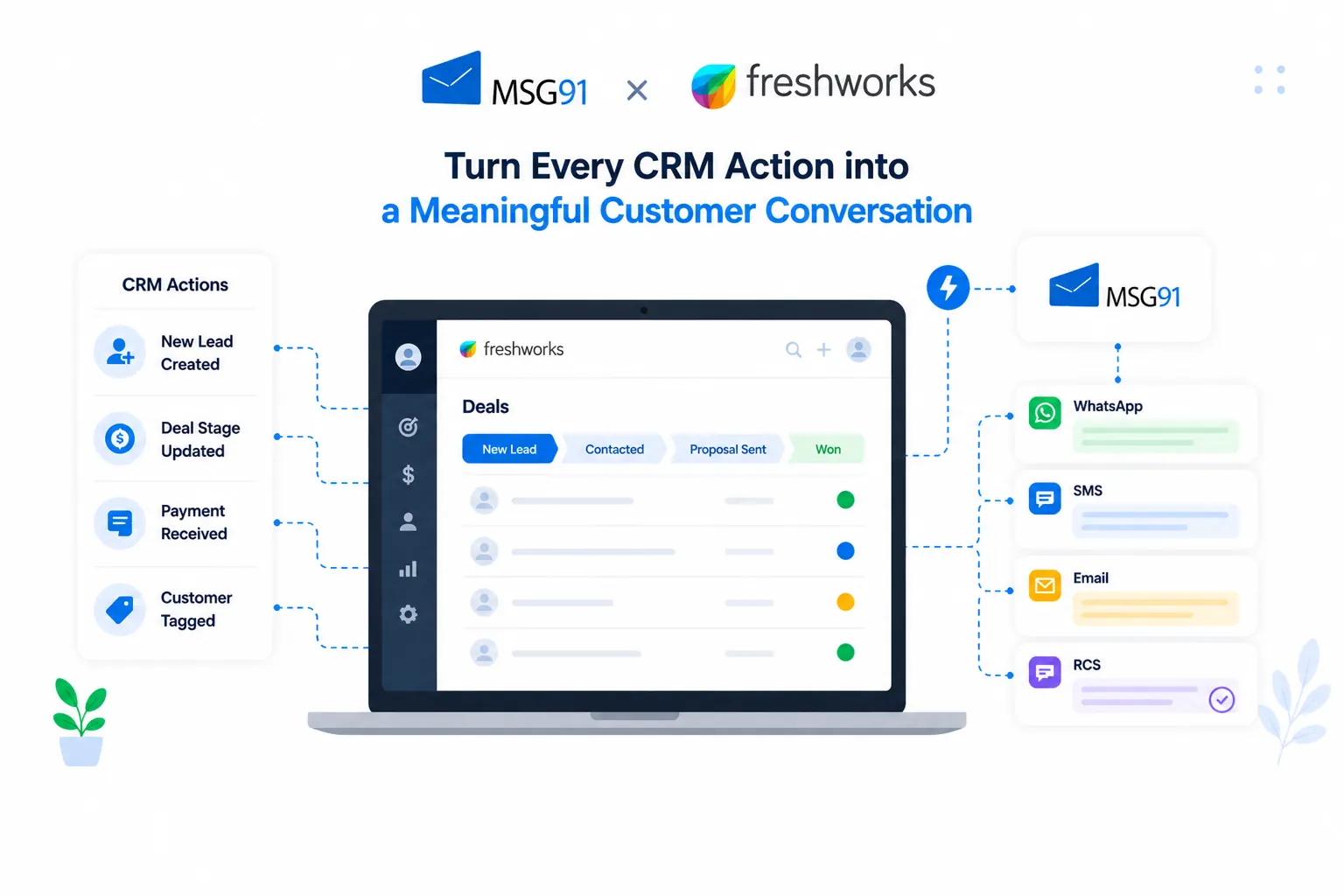
That is exactly what the MSG91 × Freshworks integration is designed to do. It connects your Freshworks CRM data with MSG91’s multi-channel messaging infrastructure SMS, WhatsApp, Email, and RCS so that the right message goes to the right person at the right time, automatically, without manual intervention.
If you have ever wanted your CRM to do more than just store contact data if you have wanted it to act on that data this integration is worth understanding.
Why CRM Data Alone Is Not Enough
Freshworks CRM is a powerful tool. It holds everything a business needs to manage customer relationships, contact details, deal stages, interaction history, pipeline status, and account information. For a sales or support team, it is the single source of truth.
But information, on its own, does not drive action. A lead sitting in the “New” stage of your pipeline does not automatically receive a welcome message. A deal that moves to “Proposal Sent” does not automatically trigger a follow-up reminder. A customer whose renewal is approaching does not automatically get a heads-up. These things happen only when someone notices and manually does something about it.
Most businesses compensate by building manual processes checklists, reminders, scheduled tasks. These work up to a point. But as the team grows and the pipeline expands, manual processes create inconsistency. Some customers get timely responses. Others wait days. The experience becomes uneven, and uneven experiences are one of the most reliable ways to lose customers who were already interested.
The MSG91 × Freshworks integration removes this inconsistency by turning CRM events into communication triggers. When something happens in Freshworks, MSG91 responds by sending a message through whichever channel makes most sense for that customer and that moment.
What the Integration Actually Does
![][image2]
At its core, the MSG91 × Freshworks integration connects two systems that were already doing their jobs separately and makes them work together. Freshworks manages the data and the workflow. MSG91 handles the communication. Together, they create an automated engagement layer that runs in the background while your team focuses on higher-value work.
Trigger-Based Automation
Every meaningful event in Freshworks, a lead being created, a deal stage being updated, a contact being tagged, a status changing from active to inactive can now become a trigger for a communication. You define the conditions, you map the message, and MSG91 handles the delivery. There is no delay, no manual step, no chance of human error.
A new lead comes in through your website and lands in Freshworks. Within seconds, that lead receives a personalized welcome message on WhatsApp. The message addresses them by name, references the product they inquired about, and invites them to take the next step. Not because someone typed it in real time because the trigger was already configured.
Multi-Channel Delivery
Different customers prefer different channels. Some respond quickly to WhatsApp messages. Others prefer a well-structured email. In certain industries banking, healthcare, logistics SMS remains the most reliable delivery format because it does not depend on an internet connection or an app being installed.
MSG91 supports SMS, WhatsApp, Email (with CC and BCC functionality), and RCS the rich messaging format that allows businesses to send product cards, image carousels, and action buttons directly inside a message thread. The integration allows businesses to choose the right channel for each workflow, or even combine channels in a single automation sequence.
For businesses that want to reach their audience on WhatsApp at the most competitive rates available, the integration supports that natively with full support for template messages, interactive buttons, and session-based conversations.
Campaign Personalization Through Dynamic Variables
Generic messages get ignored. A message that says “Dear Customer, your application is under review” feels like it was written for no one in particular because it was. The MSG91 × Freshworks integration allows businesses to map dynamic variables from CRM (customer relationship management) records directly into message templates.
This means a message can address the contact by first name, reference the specific deal they are part of, include the agent’s name, and even pull in the relevant product or service details. The message arrives feeling personal and relevant not like a broadcast, but like a considered communication from someone who actually knows the context.
Bulk Campaign Execution
Most businesses think of CRM-triggered communication as one-to-one -- a lead is created, a message goes out. But the MSG91 × Freshworks integration goes well beyond that. It supports bulk campaign execution across your entire Freshworks database -- Contacts, Deals, and Accounts -- giving teams the ability to reach hundreds or thousands of records in a single, controlled campaign launch.
The real power here lies in segmentation. Freshworks already holds detailed data about every contact, deal, and account in your pipeline. The integration lets you use that data meaningfully. You can build a campaign that targets only the accounts that have had no activity in the last 60 days -- and send them a re-engagement message on WhatsApp. You can identify leads that entered a specific deal stage three weeks ago but never moved forward -- and trigger a personalized follow-up over SMS or Email. You can pull every contact tagged under a particular industry vertical and send them a campaign announcing a product feature built specifically for them.
This is not mass broadcasting. It is precision at scale. The difference matters -- because a generic message sent to your entire database often does more harm than good. It trains customers to ignore you. A segmented campaign, on the other hand, arrives feeling relevant. The recipient sees something that actually reflects where they are in their journey with your business, and that relevance is what drives response.
Before a campaign goes out in full, MSG91 also supports test sending -- where you can push the message to a controlled sample first, review the delivery and formatting, and confirm everything looks right before the full rollout. For businesses managing large pipelines, this safeguard alone prevents the kind of embarrassing, hard-to-undo errors that come with bulk communication at scale.
Real-Time Delivery Tracking and Logs
Sending a message is only half the job. Knowing what happened after you sent it -- that is where most communication platforms quietly fail.
With the MSG91 × Freshworks integration, every message that goes out through an automated workflow or bulk campaign is tracked in real time. Delivery status, open rates, click-through data, failure reports -- all of it is logged and accessible without having to export files, cross-reference spreadsheets, or wait for a weekly report. You can see, at any given moment, exactly how a campaign is performing.
For sales teams, this visibility changes how follow-ups are timed. If a deal-stage notification was delivered and opened but generated no response, the sales rep knows the message landed -- and can make a judgment call about the next step. If it failed to deliver, that is equally important information. An undelivered message is not a cold lead -- it is a contact with a channel issue that needs to be addressed.
For businesses operating in regulated industries -- banking, healthcare, insurance, legal services -- delivery logs are not just operationally useful, they are a compliance requirement. When a regulator or an audit asks whether a customer was notified about a transaction, a policy change, or a scheduled appointment, the answer needs to be documentable. MSG91's logs provide that paper trail -- timestamped, channel-specific, and retrievable -- without any additional configuration or third-party tooling.
This level of accountability is what separates serious communication infrastructure from basic messaging tools. It is the difference between hoping your messages are working and actually knowing.
Industries That Benefit Most -- and Why
The MSG91 × Freshworks integration is not designed around a single use case or a specific type of business. The underlying principle -- that a CRM (customer relationship management) event should automatically trigger a relevant, timely communication -- applies broadly. But there are industries where the gap between manual communication and automated communication is especially costly, and where the impact of closing that gap tends to be both immediate and measurable.
E-commerce and Retail
In e-commerce, the window between a customer's interest and their decision to leave is remarkably short. Research consistently shows that cart abandonment rates hover above 70% across most retail categories -- meaning more than two out of every three customers who add something to a cart do not complete the purchase. The reasons vary -- price hesitation, distraction, uncertainty about delivery or returns -- but the pattern is consistent: the longer the gap between abandonment and re-engagement, the harder it is to recover the sale.
With MSG91 integrated into Freshworks, an abandoned cart can trigger a WhatsApp message within minutes -- not hours. The message can reference the specific product left behind, include a discount code if one is available, and link directly back to the cart. The whole interaction happens automatically, without a support agent needing to spot the abandonment, find the contact details, and manually compose a message.
The same logic applies to post-purchase communication. Order confirmations, shipping updates, and delivery notifications sent through WhatsApp or SMS see significantly higher open rates than email. Customers feel looked after. And customers who feel looked after come back.
Banking and Financial Services
Financial communication has two demands that are often in tension -- it needs to be fast, and it needs to be accurate. A transaction alert that arrives three hours late is not just unhelpful, it erodes trust. A payment reminder that carries incorrect details is worse than no reminder at all.
MSG91's infrastructure, combined with Freshworks CRM data, allows financial institutions to automate high-frequency, high-stakes communication without sacrificing accuracy. When a transaction is logged in the CRM, an SMS alert goes out immediately -- pulling the correct account reference, amount, and timestamp directly from the CRM record. When a loan repayment date is approaching, the reminder is triggered automatically based on the deal data in Freshworks -- with the customer's name, the exact amount due, and the due date populated dynamically.
SMS remains the channel of choice here for good reason. It does not require an internet connection, it is not filtered by spam algorithms, and it carries a near-100% delivery rate to active numbers. For financial services businesses that need to reach every customer reliably, every time, SMS is not optional -- it is foundational.
And because every message sent through MSG91 is logged with delivery confirmation, financial teams have a built-in audit trail that satisfies both internal compliance teams and external regulatory requirements.
Healthcare
Healthcare providers lose a disproportionate amount of operational capacity to appointment no-shows. In busy clinics and hospitals, a missed appointment is not just a lost revenue opportunity -- it is a slot that could have gone to another patient who needed it. Studies across the healthcare sector suggest that no-show rates range from 15% to over 30% depending on the specialty and patient population. The financial impact across a year is significant.
The fix is not complicated. Patients who receive timely, clear reminders are substantially more likely to show up or reschedule in advance. The challenge has always been execution -- building a system that sends the right reminder, to the right patient, at the right time, without requiring staff to manually track appointment schedules and compose individual messages.
With MSG91 connected to Freshworks, healthcare providers can build reminder workflows that trigger automatically based on appointment records stored in the CRM (customer relationship management). A reminder goes out 24 hours before, pulling the patient's name, the appointment time, the doctor's name, and the clinic location from the CRM record. A second reminder follows two hours before the appointment. If the patient needs to reschedule, a reply or a click can initiate that process without involving the front desk.
The result is fewer no-shows, better resource utilization, and a patient experience that feels organized and considerate -- all without adding to the administrative workload.
Real Estate
Real estate is a long-cycle business. A lead might browse a property listing today, attend a site visit three weeks later, and not be ready to have a serious conversation for another two months. During that entire period, staying present in the lead's mind -- without being intrusive -- is one of the most difficult things a sales team has to manage manually.
The MSG91 × Freshworks integration makes this manageable. Every deal stage change in Freshworks can trigger a contextually appropriate message. A lead who just attended a site visit receives a thoughtful follow-up that afternoon -- not because an agent remembered to send it, but because the deal stage update triggered it automatically. A lead that has been sitting dormant in the pipeline for 45 days gets a gentle re-engagement nudge with a new listing or a market update that might reignite their interest.
What makes this especially valuable in real estate is the compounding effect. A team of five agents manually following up on 200 leads will inevitably be inconsistent -- some leads get attentive follow-up, others slip through. With automated workflows, every lead in the pipeline receives the same quality of attention regardless of how busy the team is. And in a market where a single deal can represent significant commission value, the cost of letting one lead go cold unnecessarily is very real.
SaaS and Technology
For SaaS businesses, the first few days after a user signs up are arguably the most important period in the entire customer lifecycle. Users who successfully complete onboarding and reach their first meaningful activation moment are dramatically more likely to convert to paid plans and remain customers long-term. Users who sign up, feel lost, and quietly stop logging in -- a phenomenon sometimes called silent churn -- represent a significant and often invisible revenue leak.
MSG91 integrated into Freshworks allows SaaS teams to build onboarding communication sequences that trigger from the moment a new user record is created in the CRM. Day one: a welcome message with the three most important first steps. Day three: a check-in that asks if there are any questions. Day seven: a prompt to explore a feature the user has not yet tried. Each message is timed, personalized with the user's name and plan details, and delivered through the channel most likely to be seen.
Beyond onboarding, the integration handles renewal reminders, feature announcements for specific plan tiers, and win-back campaigns for users whose accounts have gone inactive. Every one of these touchpoints, handled manually, requires someone on the team to identify the right users, draft the right message, and send it at the right time. Automated through MSG91 and Freshworks, they happen in the background -- consistently, at scale, without consuming team bandwidth.
Setting It Up Simpler Than It Sounds
One concern businesses often raise about CRM integrations is complexity. Will it require developer involvement? Will it take weeks to configure? Will it break when either platform updates?
The MSG91 × Freshworks integration is designed with simplicity as a core requirement. The setup involves configuring the MSG91 API and Authkey within Freshworks, mapping the relevant CRM events to MSG91 campaigns, and setting the dynamic variables for each message template. No custom development is required. The integration can be configured and tested within a single working session.
Pre-built workflow templates are available for common use cases, such as welcome messages, deal update notifications, payment reminders, and feedback requests. Businesses can use these as-is or customize them to fit their specific process. Either way, the operational overhead of maintaining the integration is minimal once it is running.
For teams that want to explore the setup process or discuss their specific workflow requirements, connecting with the MSG91 team is the fastest way to get a practical walkthrough.
The Business Case: What This Actually Changes
It is easy to frame an integration like this in technical terms: triggers, channels, variables, and logs. But the actual value shows up in simpler, more tangible ways.
Response time improves. When a lead enters the CRM and receives a relevant message within minutes instead of hours, the probability of that lead converting increases substantially. Speed of response is one of the most consistent predictors of deal success, particularly in competitive markets.
Follow-up consistency improves. Every lead gets the same quality of follow-up, regardless of which agent is managing the account or how busy the team is that day. Consistency builds trust, and trust builds pipelines.
Manual effort decreases. Every message that is triggered automatically is a message that did not require someone to draft, review, and send manually. Over a month, that adds up to hours of recovered time per team member time that can be redirected toward conversations that actually require human judgment.
Customer experience improves. At the receiving end of all this, the customer gets the impression of a business that is attentive, organized, and professional. They receive relevant information at the right time. They do not wait days for a reply. They do not receive generic messages that feel impersonal. And that impression formed through dozens of small interactions determines whether they stay, refer others, or move on.
Conclusion
The best CRM in the world is only as useful as the actions it enables. Freshworks gives businesses an exceptional foundation for managing customer data and sales workflows. MSG91 gives businesses the communication infrastructure to act on that data automatically, across multiple channels, at scale.
Together, they close the gap between knowing and doing. The lead enters the CRM and the welcome message goes out. The deal stage changes the follow-up triggers. The renewal date approaches the reminder sends. None of it requires a team member to remember, check, or manually execute.
For businesses that are serious about building a customer communication strategy that is reliable, personalized, and scalable, the MSG91 × Freshworks integration is not a nice-to-have feature. It is the infrastructure that makes consistent, high-quality communication possible without proportionally increasing the team’s workload.
The setup takes hours. The impact lasts as long as the business does.
Frequently Asked Questions
1. What is the MSG91 × Freshworks integration?
It is a native integration between MSG91’s multi-channel messaging platform and Freshworks CRM. It allows businesses to trigger automated SMS, WhatsApp, Email, and RCS messages based on events and status changes within Freshworks such as lead creation, deal updates, or contact tagging without any manual intervention.
2. Which communication channels does the integration support?
The integration supports SMS, WhatsApp, Email (with CC and BCC functionality), and RCS. Businesses can configure different channels for different workflows depending on the nature of the message and the customer’s preferred communication medium.
3. Do I need a developer to set up the integration?
No. The integration is designed for non-technical users. Setup involves configuring the MSG91 API credentials within Freshworks and mapping CRM events to MSG91 campaigns through a visual workflow interface. Pre-built workflow templates are available for the most common use cases.
4. Can I personalize messages with CRM data?
Yes. The integration supports dynamic variables that pull data directly from Freshworks records including contact name, deal details, agent name, product information, and more. This allows businesses to send messages that feel genuinely personal rather than generic broadcasts.
5. Is it possible to send bulk campaigns using Freshworks contact segments?
Yes. The integration supports bulk campaign execution across Contacts, Deals, and Accounts. Businesses can define specific segments based on deal stage, account status, engagement history, or custom fields and launch targeted campaigns to those groups with controlled deployment and test-send options.
6. How does real-time tracking work?
MSG91 provides detailed delivery logs and engagement metrics for every message sent through the integration. Businesses can monitor delivery status, open rates, and click-through data in real time, making it straightforward to assess campaign performance and identify any delivery issues quickly.
7. Which industries benefit most from this integration?
The integration is applicable across any industry that manages customer relationships through a CRM. It is particularly effective in e-commerce and retail, banking and financial services, healthcare, real estate, travel and hospitality, and SaaS where timely, automated communication has a direct and measurable impact on conversion rates and customer retention.
8. What happens if a message fails to deliver?
MSG91’s platform logs all delivery attempts and flags failures in real time. Businesses can review failed deliveries in the logs, identify the cause whether an invalid number, a carrier issue, or a template rejection and take corrective action. Retry logic can also be configured for specific channel types.
9. Are there pre-built workflows available for common use cases?
Yes. The integration comes with ready-made workflow templates for common communication scenarios including welcome messages, deal update notifications, abandoned cart reminders, payment alerts, appointment reminders, and renewal follow-ups. These can be used directly or customized to fit specific business processes.
10. How does this integration help reduce manual workload for sales and support teams?
By automating communication triggers based on CRM events, the integration eliminates the need for team members to manually draft and send routine messages. This frees up time for higher-value interaction calls, strategic follow-ups, and complex negotiations while ensuring that every contact in the pipeline receives timely, consistent communication regardless of team bandwidth.